
Server connection (live)
Overview
Section titled “Overview”Server connection opens the world of a running Minecraft server (Paper) in the editor so you can edit it directly. Install the NPBridge plugin on the server and connect from the editor’s Server window to enter live mode.
- The server world is the source of truth. You don’t pick a region: the editor keeps loading the chunks around the camera.
- Blocks you place and break in the editor reach the server right away, and blocks changed in the game show up in the editor right away.
- When you edit World logic rules or scene actors, the changes apply right away without restarting the server.
- Editor coordinates and server coordinates are the same.
Server-side setup (install, token, port, security) is covered in Installing NPBridge (server admins). The 0.11.1 installer includes NPBridge 2.4.0.
New in 0.11.0: live work is saved as an
.npworldwork file, and if you open that file later and connect to the same server, you continue where you left off (see “Saving work and resuming” below). New features such as physics, weather cues, sequencer figures, and lens differ by server version (“New features and server versions”).
New in 0.10.3: View in game in the animation editor and animated props placed in the map (scene
rigactors) work on servers running NPBridge 2.0.9 or later (Exporting animations and viewing in game).
New in 0.10.2: logic that uses the new Logic graph flow nodes (Gate · Return · Do Once · Flip Flop · Switch) or the math functions
inverse_lerp·wrap·snapis uploaded only to servers running NPBridge 2.0.8 or later (Connecting to an older NPBridge).
Basic use
Section titled “Basic use”The images on this page show the screen before connecting and were taken without a real server. The address play.example.com is an example. The screen after connecting is described in text.
Connecting
Section titled “Connecting”You need the address of a server with NPBridge installed and a token from the server admin.
-
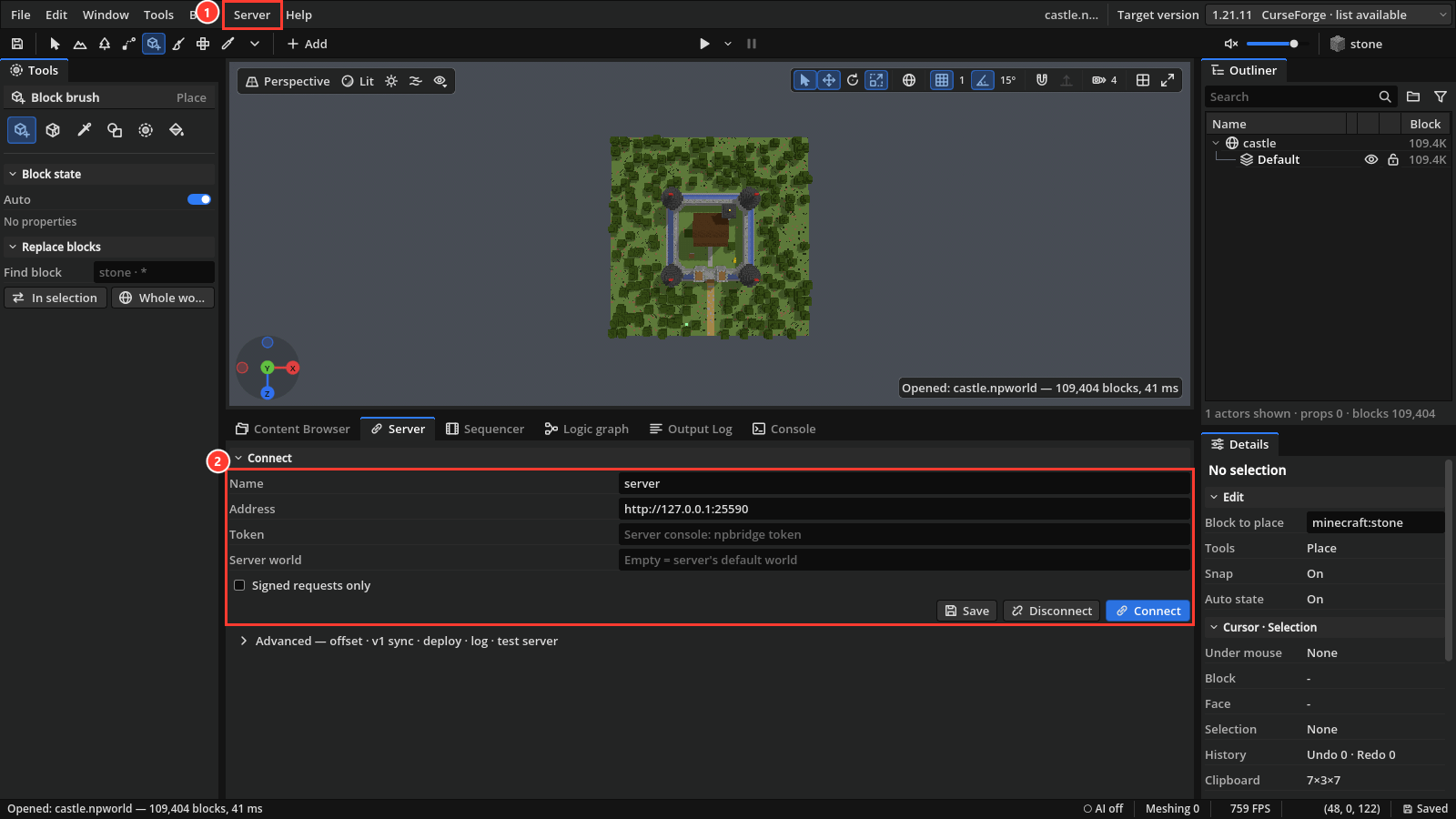
In the menu bar, click Server > Server window. The Server tab opens in the bottom dock area. The Connect section at the top has the Name, Address, Token and Server world fields and the Save, Disconnect and Connect buttons.
-
In the Name field, type a name to identify this connection (for example
play). In the Address field, typehttp://<server address>:25590.25590is the default NPBridge port. It differs from the Minecraft port (25565and so on).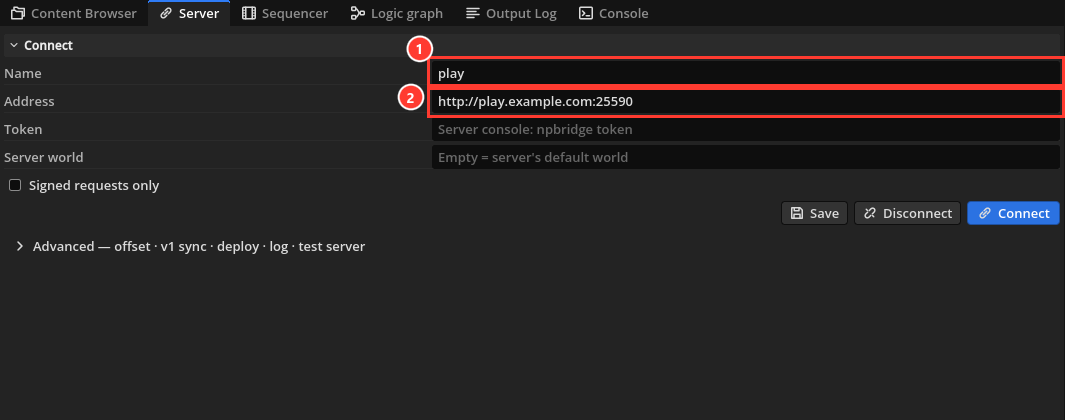
-
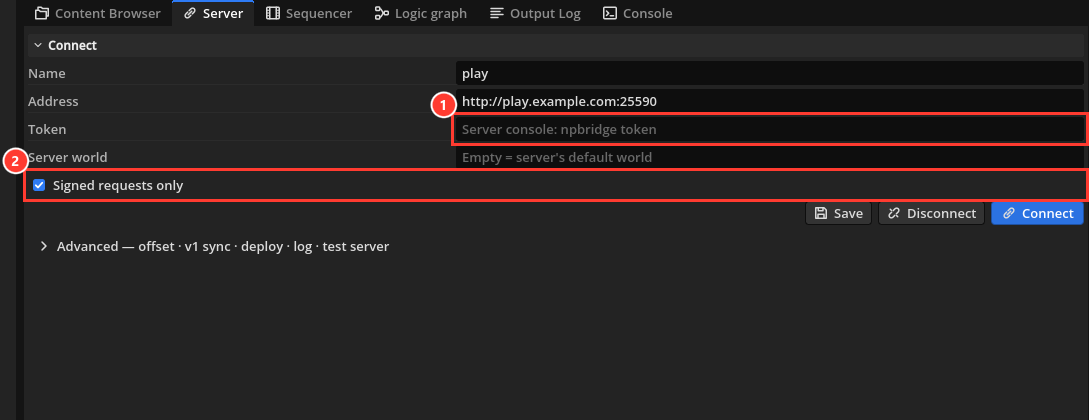
Type the token in the Token field. The text you type is masked. If the server runs NPBridge 2.0.3 or later, turn on Signed requests only. To open a world other than the server’s default world, type its name in the Server world field (leave it empty for the default world).
-
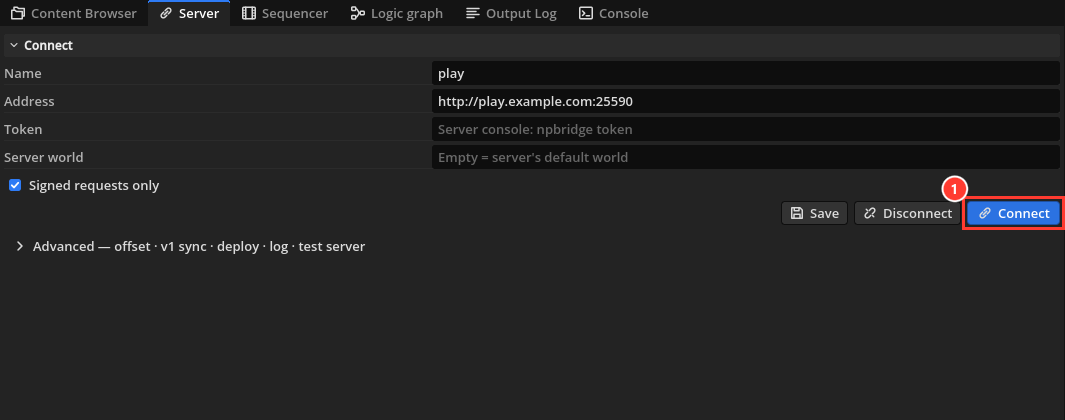
Click Connect.
-
If the current map has unsaved changes, the dialog “Connecting to the server opens the server world instead of the current map (the server is authoritative). …” appears. Click Save and connect, Discard and connect or Cancel. Discard and connect also keeps the current state in the autosave file before connecting.
-
Once connected, the server world opens instead of the current map and the chunks around the camera load. The status bar shows a “Server live:
· · N chunks · N ms” item (the ms at the end is the round trip time to the server). Click this item to open the Server window. The Server window shows the Live, Integrity check, Server scene and Online players sections.
Keeping the connection settings
Section titled “Keeping the connection settings”- Click Save in the Connect section of the Server window. The name, address, token and server world are stored in your user folder on this PC with Windows data protection (only this user on this PC can read them). If you only click Connect, the settings are not saved.
- From then on, click Server > Connect · reconnect to connect right away with the saved settings.
Editing live
Section titled “Editing live”| What | Behavior |
|---|---|
| Blocks | Placing, breaking, brushes and shapes go to the server right away. Undo and redo go to the server too. Undo reverts only your own edits, not changes made by other people or by the game. |
| Changes in the game | Blocks placed and broken by players, and blocks changed by commands or other plugins, show up in the editor. |
| Entities | Players, mobs, item frames, armor stands and scene actors move as boxes with name tags. Turn them on or off with Show server entities (players · mobs · item frames …) in the Server window or Server entities in the show flags menu of the viewport bar. |
| Scene logic | When you edit rules, actors or variables, they apply right away without restarting the server. Variables, flags and running actions are kept. |
| Online players | Double-click a row in the Online players list to move the camera to that player. |
| Load range | Load radius in the Live section (2–32 chunks, default 12). A larger radius uses more memory and network. Selecting another server world in World loads that world’s chunks from scratch. |
| AI Studio | You can work with AI Studio while live. AI edits go to the server too. While live, the AI cannot open or create maps. |
Saving
Section titled “Saving”- Press Ctrl+S to save the server world and scene state to the server’s disk. Clicking Save to server in the Live section does the same.
- Turn on Also save a local copy (.npworld) on Ctrl+S to also save the received blocks on this PC as
.npworld. - Save local copy… saves only the blocks received so far as
.npworld(the server is unchanged).
Disconnecting
Section titled “Disconnecting”- Click Disconnect in the Server window. Clicking Server > Disconnect… does the same.
- In the “Disconnect from the server? …” dialog, click Disconnect. The editor first sends any edits that have not been sent yet, saves the work file (
.npworld) if you changed anything, and then disconnects. To leave no work file, click Disconnect without saving. The server world stays on the server, and the blocks received in the editor remain as the current map.
- If you click File > New (Ctrl+N) or File > Open… (Ctrl+O) while live, the editor asks first. Click Disconnect and create new or Disconnect and open to disconnect and continue, or click Cancel to keep the connection and the map as they are.
- If the server restarts or the network drops, the editor reconnects by itself. Edits made in the meantime are sent once it is connected again.
Saving work and resuming
Section titled “Saving work and resuming”You can keep what you built live as an .npworld work file, and if you open that file later and connect to the same server, you continue where you left off. For blocks, the server world always wins (a cell that someone broke in the meantime comes back broken).
-
Work while connected. The work file is saved at three times.
- When you disconnect (Disconnect) — automatic, only if you changed something
- At a set interval — Work autosave interval in the Server live group of Edit > Editor Preferences… > General (default 180 seconds, 0 = off, only if you changed something)
- By hand — File > Save work (server live) or Save work in the Server window
The file is the
.npworldyou have open; if there is none, a newlive_<server>_<world>_<time>.npworldis made in the project folder (a new name for each connection — it does not overwrite earlier work). When you save by hand, the notice “Work saved: … — open this file later and connect to the same server to continue” appears. -
Later, open that work file with File > Open…. Before you connect to the server, the notice and a yellow field in the status bar show “Not synced with server ·
· last synced -
In the Server window, click Connect to the same server (address
host:port+ world name). It connects without clearing the map, and the progress window “Resume — syncing with the server” (chunk column n/N · changed cells · Cancel) receives the file’s columns from the server and matches them to the server’s values without asking. Editing is blocked while it syncs, and the undo history is cleared at the start and the end (so Ctrl+Z cannot send the file-era blocks to the server). -
When it ends, a summary “Updated N blocks to the server state — N chunk columns” appears, and changed cells show as red boxes. The Output Log keeps a “file → server” line for each cell, and the Server window keeps a Different blocks list.
Non-block data (logic graphs, sequences, scene actors) is decided by whether the server scene changed.
| Server scene | Result |
|---|---|
| Same as the last sync recorded in the file | The file’s data is used. If you edited anything offline, it is uploaded to the server after the sync ends. |
| Changed in the meantime (another person, a reinstall, a deletion) | The server’s wins. Actors deleted on the server are deleted in the editor too, and new actors that the server did not have are kept. Logic I changed after the last sync is kept as a logic copy, and the notice window “Resume — what the server won” appears. |
| An old file with no last-sync baseline | The server’s wins, no copy is made, and it tells you ”… could not tell whether you edited the logic (no copy was made)”. |
- Upload this copy… in the notice window replaces the server scene logic (rules, variables, sequences) with that copy’s logic (it asks for one more confirmation and cannot be undone). Discard this copy… deletes the copy. Up to the 5 most recent copies stay in the work file, so even after you disconnect and reconnect, you can use Upload… (only for copies that match the current scene and world) or Discard… in the “Copies of my logic lost when the server won” list in the Server window.
- When the server wins, a copy of the work file before resuming is kept as
<name>.before-resume-<time>.npworld(the 5 most recent). - For a different server or a different world, it does not sync automatically and the warning “This work file was made on a different server (…). …” appears. Click Connect to the server world to receive the server world fresh as before (the work file stays on disk).
- Of the edits not sent to the server at save time, and the cells changed without the server, those that differ from the server are discarded, and “Discarded because the server wins: N blocks — …” tells you.
- While resuming (syncing with the server), the AI Studio refuses tools that change the world (read-only tools keep working). Ask again after the sync ends.
- During ▶ Play and Simulate, the periodic save is postponed, and disconnecting or Save work stops Play before saving. Quit without saving in the quit window does not write the work file either.
Tips and tricks
Section titled “Tips and tricks”- The gray placeholder “Server console: npbridge token” shown while the Token field is empty is the server command that shows the token. Ask the server admin for the output of this command.
- If the Address or Token field is empty, clicking Connect does not contact the server, and the status text below the section tells you right away (for example “The address is empty — e.g. http://server-address:25590 (NPBridge default port)”).
- Before you use the new 0.10.2 flow nodes in a blueprint, check the server’s NPBridge version. Servers older than 2.0.8 do not receive that logic (Connecting to an older NPBridge).
Reference
Section titled “Reference”Connecting to an older NPBridge
Section titled “Connecting to an older NPBridge”| Server version | Editor behavior |
|---|---|
| NPBridge 1.x | Connects the old v1 way without live mode, and only the features under Advanced — offset · v1 sync · deploy · log · test server work. Replace the server plugin with NPBridge 2.0.9. |
| 2.0.0 – 2.0.2 | These versions don’t know request signing, so the token is sent in plain text and the Server window shows “This server runs an old NPBridge, so the token is sent in plain text — …”. With Signed requests only on, the editor does not connect to such servers. |
| 2.0.7 or earlier | Logic that contains the new flow nodes or the math functions inverse_lerp · wrap · snap is not uploaded through the live link and is not deployed as a scene. The Server issues section and a notification show “The server’s NPBridge 2.0.7 does not know the new nodes (…), so the logic was not uploaded — …”. Other live features such as blocks, entities and saving keep working. |
| 2.0.8 | View in game stops with “The server’s NPBridge is older than 2.0.9 — put NPBridge 2.0.9 on the server to use “View in game"", and animated props in the map go out as still displays. Other live features keep working. |
| 2.0.9 or earlier | The new features of 0.11.0 (physics, weather cues, new trigger rules …) are left out or skipped as described in “New features and server versions” below. |
| Servers that don’t report their version | Logic with new nodes is blocked with “The server did not report its NPBridge version, so logic with new nodes (…) was not uploaded — …”. |
Older servers skip actions they don’t know and run the next actions as usual. To keep actions such as rewards guarded by a Gate from being unlocked, the editor does not upload the logic. Replace the server plugin with the NPBridge.jar (2.4.0) from the installer and reconnect (Installing NPBridge).
New features and server versions
Section titled “New features and server versions”When it connects, the editor reads the version and feature list the server reports, and for a server that does not know a feature it leaves that cell out of the upload or only warns. Warnings stay in the Server window log and notices.
| 0.11.0 feature | Version needed | On an older server |
|---|---|---|
| Physics bodies · rigid bodies · timed physics | 2.1.0 | “N physics bodies were not sent because this server (NPBridge below 2.1.0) doesn’t know them — …” |
| Weather cues (a sequence’s weather keys and lightning keys) | 2.1.0 | “Weather cues (N sequence(s)) play on server NPBridge 2.1.0 or newer — older servers ignore them (cutscene only, no rain · lightning)” |
| Rules with new triggers (command · chat · player events) | 2.4.0 | Only that rule is skipped (live sync is not blocked; the Server window shows a notice). An older trigger + Text compare blocks the logic upload and scene deploy |
| Moving block groups | 2.4.0 | Uploaded without the groups: “N moving block groups weren’t uploaded — this server lacks the feature ‘blockgroup’ (NPBridge below 2.4.0) …”. Scene deploy is blocked |
| Sequencer figures (display actors moved by the Sequencer) · world-position sound | 2.2.0 | “N sequencer fighter(s) were pushed without baked poses because this server (NPBridge below 2.2.0) does not know them (…)” |
| Fade key colors · sky time | 2.2.1 | Warning only (one sequence fade color · the world time stays) |
| Cut lens (FOV · focus · depth of field) | 2.3.0 | Warning only (the player’s FOV stays · no depth of field) |
Moving block groups, commands, chat, and the new player events are handled by server NPBridge 2.4.0 or later (the version in the 0.11.1 installer). If the feature list the server reports lacks a feature (2.3.0 and earlier), the editor does not upload groups and blocks a scene deploy that has them; the server skips the new trigger rules, and the Server window shows a notice — World logic.
Integrity check
Section titled “Integrity check”Compares the blocks on the server and in the editor. The server is the source of truth, so blocks that differ are fixed to match the server.
- In Region in the Integrity check section, select All loaded chunks or Visible only (around the camera), then click Integrity check. If you turn off Fix differences to match the server right away, only the list of differing blocks is shown; review it, then click Fix to match server.
- Click a row in the list of differing blocks to move the camera to that block. With Integrity mismatches on in the viewport show flags menu, differing blocks briefly appear as red boxes.
- While live, Auto check is on by default: every 30 seconds it checks the area around the camera and fixes differences to match the server. It waits while you edit or chunks are loading.
- Fixes made to match the server are not added to the undo history.
Server scene controls
Section titled “Server scene controls”Control the server’s scene directly in the Server scene section. These controls affect online players immediately, so Stop, Restart and Reset ask first.
| Field · button | Action |
|---|---|
| Editing scene | The server scene paired with the editor logic. Changing it loads that scene from the server. |
| Start · Stop · Restart · Reset | Start, stop and reload the scene. Reset clears variables, flags and “Do Once” records. |
| Debug (receive rule fires · node runs) | Shows rules firing on the server in the Logic graph. |
| Rule firing | Fires the selected rule on the server manually (the server checks the conditions). |
| Change server value | Changes the server value of the selected variable. |
| Recent fires · Server issues | Fire records and issues sent by the server |
Connecting with several editors
Section titled “Connecting with several editors”When several editors connect to the same server and world, each sees the others’ block edits right away, and the other editors’ cameras, names and selection boxes also appear in the viewport.
- The Connected editors list in the Server window shows the other editors in the same world. Turn on Follow to make the camera follow that editor.
- My name field = the name other editors see.
- Turn the display on or off with Other editors in the viewport show flags menu.
- For scene logic, whatever was sent last stays on the server. Have one person handle the logic (Co-building).
Preferences
Section titled “Preferences”The Server live group in Edit > Editor Preferences… > General:
| Setting | Default | Meaning |
|---|---|---|
| Custom blocks (np:) | Send as server form (note block mapping · default) | Editor-only custom blocks placed while live are placed on the server as note block states and shown as custom blocks again when received. You can also select Editor only (overlay) or Off (erased when re-downloaded). Takes effect from the next connection. |
| Group server scene actors in a folder | On | Groups the server scene’s actors under one “Server scene: |
| Work autosave interval | 180 s | 0 to 3600. 0 = off. It always saves when you disconnect. |
| Automatic integrity check | On | Compares the area around the camera with the server at the set interval. |
| Auto check interval | 30 s | 10–3600 s |
Custom blocks and resource pack deployment
Section titled “Custom blocks and resource pack deployment”- A custom block (
np:<id>) used in a block field of logic or in a moving block group is converted to a note block state and sent to the server, both in live upload and in scene deployment. When the server scene is loaded, it is converted back tonp:<id>. If the Custom blocks (np:) setting is Editor only (overlay) or Off (erased when re-downloaded), a warning thatnp:blocks are not placed on the server is recorded once in the Server window log. - When you deploy the Resource pack from the Deploy group in the Server window, the painted textures and materials (LabPBR) go into the pack as in the export window. If Material (LabPBR) in the export window is Separate add-on pack, the materials are not put into the server pack, and the report tells you.
Shortcuts
Section titled “Shortcuts”| Shortcut | Action |
|---|---|
| Ctrl+S | Save to server (while live) |
| Ctrl+N · Ctrl+O | Ask about disconnecting first, then create new · open |
| Ctrl+Alt+L | Turn v1 sync on/off (old method, Advanced — offset · v1 sync · deploy · log · test server) |
Troubleshooting
Section titled “Troubleshooting”| Symptom | Cause | What to do |
|---|---|---|
| “The token is empty — …” · “The address is empty — …” | The field is empty | Fill in the field, then click Connect. |
| “Nothing is listening on this port — …” | NPBridge is off, or the port differs | Check that listening on …:<port> in the server log matches the port in the address. |
| “No response — …” · “Response timed out — …” | A firewall or router blocks it, allow_ips | Ask the server admin to open the port for the editor PC’s IP. |
| “Address not found — …” | Typo in the server address | Fix the address. |
| “Cannot connect with https — NPBridge uses http (start the address with http://)” | The address uses https:// | Start it with http://. |
| “There is no NPBridge at this address — …” | Another program (the resource pack server on 25580 and so on) answers on that port | Set the port in the address to the NPBridge port (default 25590). |
| “Wrong token — …” | The token is wrong, or the server created a new token | Get the token again from the server admin and enter it. |
| “The server blocked this PC …” | This PC’s address is not in the server’s allow_ips | Tell the server admin. |
| “This PC’s clock differs a lot from the server clock — …” | The PC clock is more than 60 seconds off from the server | Sync the Windows clock with internet time, then reconnect. |
| “The server’s live connection slots are full …” | Simultaneous connection limit (default 16) | Close another editor connection, or reconnect after 2 minutes. |
| You edited the logic but the server still behaves the old way | The old NPBridge doesn’t know the new nodes and did not receive the logic · the server scene is stopped | Check the Server issues section. Connecting to an older NPBridge · Start in Server scene |
| “The scene couldn’t be received, so logic · actor edits aren’t sent to the server (retrying) — …” | The server scene could not be received. Until then, logic and actor edits are not sent to the server. | The editor retries at intervals. If it continues, check the Server issues field and the server log. |
| “Discarded because the server wins: N blocks — …” | When resuming, edits not sent to the server at save time, or cells changed without the server, differed from the server. | Normal behavior (the server wins for blocks). The list of discarded cells is in the Output Log. Build them again if needed. |
| “Resume failed: …” | An error while connecting or syncing to resume. For example “Could not receive chunks from the server” | Check the connection and the server state and connect again. Chunk columns that could not be synced are unloaded from the editor and received fresh from the server when the camera goes there. |
| “This work file was made on a different server (…). …” | You connected to a server or world different from the work file’s. | Connect to the same address and world, or receive the server world fresh with Connect to the server world. |
Related docs
Section titled “Related docs”Not an official Minecraft product. Not approved by or associated with Mojang or Microsoft.